Tempered vs Laminated Glass: Which Should You Use for Replacement?
Short answer: tempered (toughened) glass is heat-treated to be about four to five times stronger than ordinary glass and breaks into small, blunt pieces. Laminated glass is two or more layers bonded with a plastic interlayer, so when it breaks the pieces stay stuck together and the panel stays in its frame. Choose tempered for strength and impact in doors, shower screens and partitions; choose laminated where glass must stay in place after breaking, such as balustrades, overhead glass, shopfront security and facades over walkways.
When glass breaks and needs replacing, the most important decision is not the price but the type. Putting the wrong glass back can create a safety risk, fail building requirements, or leave you with a panel that does not match the rest of the facade.
What is tempered glass?
Tempered glass is ordinary float glass that is cut to size, edge-finished, heated to a high temperature and then cooled rapidly. This puts the surface under compression and the core under tension, which makes it much stronger against impact and heat.
Key points:
- Breaks into small granular pieces, reducing the risk of serious cuts
- Much more resistant to thermal stress than ordinary glass
- Cannot be cut, drilled or edge-worked after tempering, so every piece is made to order
- Usually carries a small permanent mark in one corner
- Can very rarely break spontaneously because of nickel sulphide inclusions; heat soak testing reduces this risk
What is laminated glass?
Laminated glass is made by bonding two or more sheets of glass with an interlayer, commonly PVB, or stiffer interlayers for structural uses. When struck, the glass may crack, but the interlayer holds the fragments in place.
Key points:
- Stays in the frame after breaking, acting as a barrier
- Slows down forced entry, because the interlayer must be cut through
- Reduces noise transmission
- Blocks most UV, protecting interiors and displays from fading
- Can use ordinary, heat-strengthened or tempered glass layers
Tempered vs laminated: key differences
| Feature | Tempered | Laminated |
|---|---|---|
| Strength | High | Depends on the glass layers used |
| How it breaks | Shatters into small blunt pieces | Cracks but stays bonded |
| Stays in frame after breaking | No | Yes |
| Security | Moderate | High |
| Sound reduction | Low | Better |
| UV protection | Low | High |
| Can be cut after manufacture | No | Ordinary laminated can be cut; tempered laminated cannot |
| Typical cost | Lower | Higher |
Where each type is usually used
| Location | Usual choice | Why |
|---|---|---|
| Shower screens | Tempered | Strength and safe breakage |
| Glass doors and partitions | Tempered, or laminated for privacy and acoustics | Impact resistance |
| Balcony balustrades | Laminated, often tempered laminated | Must stay in place if broken |
| Skylights and canopies | Laminated | Prevent glass falling on people below |
| Shopfronts | Laminated or tempered laminated | Security and safety |
| High-rise facades | Coated tempered, heat-strengthened or laminated units, often double glazed | Wind loads, heat and fall protection |
What about facades?
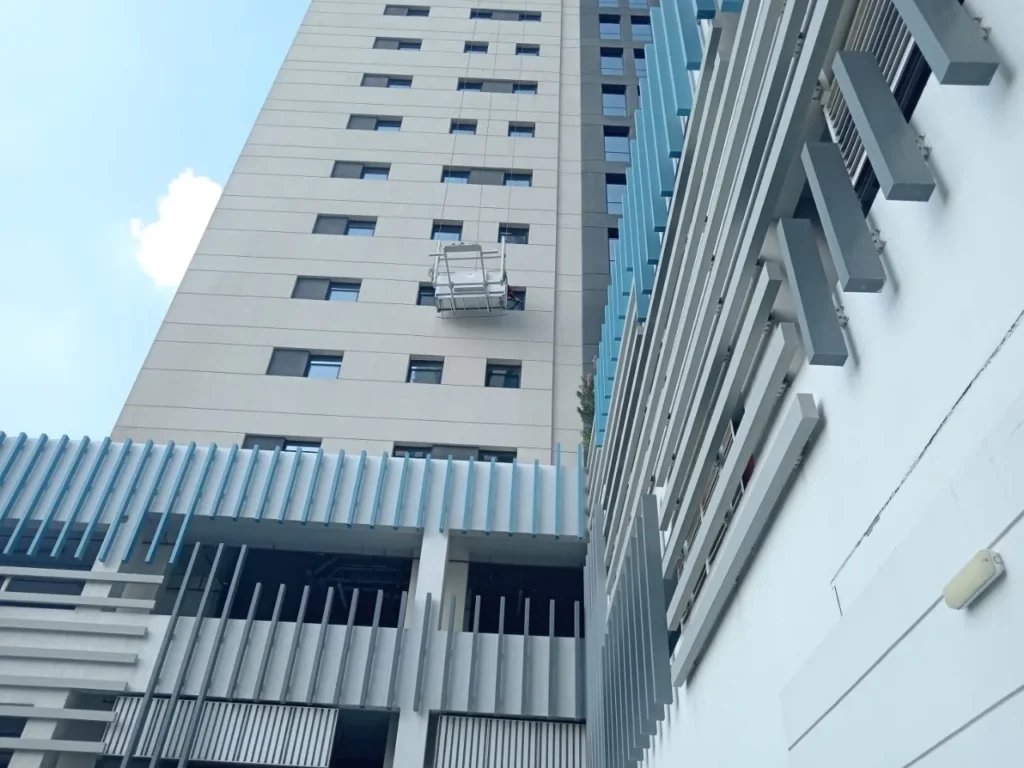
Facade glass is chosen by facade engineers for wind loads, solar control and safety. Many facades use double glazed units with a laminated or tempered layer. When a facade panel breaks, the replacement must match the original specification, including thickness, coating, tint and build-up. Replacing a laminated panel with tempered glass to save money can remove an important safety feature.
How to tell which glass you have
- Look for a small etched or printed mark in a corner, which often states the type and standard.
- Look at the edge: laminated glass shows the interlayer as a thin line between sheets.
- Check building drawings or handover documents.
- If broken, the break pattern tells you: small cubes for tempered, a cracked web held together for laminated.
Replacing broken glass safely
When glass breaks, make the area safe, avoid touching hanging pieces, and record the glass type and size before removal. A glazier should confirm the specification and order the right glass. Tempered and laminated glass are both made to order, so temporary boarding may be needed while you wait.
Our team handles broken glass replacement for homes and shops, facade glass replacement on buildings, and glass door replacement with the correct safety glass.
Questions people ask about tempered and laminated glass
Which is stronger, tempered or laminated glass?
Tempered glass is stronger against impact than ordinary laminated glass. Laminated glass is safer after breaking, because it stays in place.
Can glass be both tempered and laminated?
Yes. Tempered laminated glass combines strength with post-breakage retention and is common in balustrades and high-risk locations.
Why did my tempered glass shatter by itself?
Hidden edge damage, thermal stress or a nickel sulphide inclusion are the usual causes.
Is laminated glass bulletproof?
Standard laminated glass is not. Bullet-resistant glass uses many layers and is a specialised product.
Which glass is better for a shower screen?
Tempered glass is the usual choice.
Is laminated glass worth it for a villa?
For balconies, skylights and ground-floor glass where security matters, often yes.
FREE SITE INSPECTION
Need the right glass replaced?
We replace tempered, laminated and double glazed glass in homes, shops and buildings across Dubai. Send a photo on WhatsApp for advice and a quote.